An ASX-listed share does not trade in one place. It trades on two licensed exchanges, in more than one way on each, and in transactions negotiated away from every order book and reported afterwards. A VWAP is only as wide as the trade set behind it, so where the venue line is drawn changes the number.
The ASX VWAP definition reads the rule clause by clause and which trades count and which are excluded works through the trade types. This one is about where the trades happen, and it closes the loop the definitional guide leaves open on venue.
Where ASX-listed shares actually trade
The ASX central order book. ASIC's rules define ASX TradeMatch as the order book operated by ASX that is "the Central Order Book of ASX for Equity Market Products" (ASIC Market Integrity Rules (Securities Markets) 2017, rule 1.4.3). This is the book most people picture when they picture the market: orders entered, amended and matched on a continuous basis, over hours that also include "a time during which an Auction is conducted on the Market" (ASIC Market Integrity Rules (Securities Markets) 2017, rule 1.4.3). Read the auction definition carefully before going further than that. Its general limb is an auction "conducted in a Trading Platform", and it names ASX TradeMatch only for the purposes of Part 8.2 of those rules, so the definition does not by itself put every auction in an equity market product on that book (ASIC Market Integrity Rules (Securities Markets) 2017, rule 1.4.3). The auction the rules do locate in time is the one at the end of the session, which the post-trading hours exception is drafted around (ASIC Market Integrity Rules (Securities Markets) 2017, rule 6.2.4).
The rulebook expression for an order visible before it trades is pre-trade transparent, and the obligation built on it is that a participant must not enter into a transaction unless it is entered into by matching a pre-trade transparent order on an order book, subject to a list of exceptions (ASIC Market Integrity Rules (Competition in Exchange Markets) 2011, rule 4.1.1). That text is from the 2011 competition instrument, which was repealed with effect from 7 May 2018 (ASIC Market Integrity Rules (Securities Markets) 2017, rule 1.1.3A), and the operative text now sits in rule 6.1.1 of the 2017 Securities Markets rules, which restates the obligation and carries the same six exception limbs forward in the same order (ASIC Market Integrity Rules (Securities Markets) 2017, rule 6.1.1). Everything else below exists because that structure carries exceptions.
ASX Centre Point. ASX's condition-code table carries its own rows for
Centre Point: a Centre Point trade auto matched during continuous trading
between different participants (CX), the same thing as a crossing by one
participant (CXXT), a preference matched variant (CPCXXT), and separate
rows for Centre Point trade reporting. Every one of those is flagged as
updating ASX VWAP; the exception in the family is a Centre Point booked
transaction resulting from Unintentional Crossing Prevention (BPCXXT),
which is not (ASX trade condition codes, v3.7). So Centre Point trading is
ASX trading, most of it is matched during continuous trading, and all of
it arrives in the data under codes of its own.
The second exchange. TMX Australia Exchange "operates a licensed financial market in Australia for the execution of transactions in financial products", and the classes tradeable on it include equity market products (TMX Australia Exchange Operating Rules, Introduction and rule 4.4). Two order types are admitted, limit orders and pegged orders "that are referenced to a source specified in the procedures", and orders are matched "based on price/visibility/time priority" (TMX Australia Exchange Operating Rules, rule 4.5). Note what that vocabulary does and does not give you. The rules do not use the words lit or dark, and they name no separate mid-point book. Visibility is an attribute of an order and an input to matching priority, and since the rulebook admits only two order types, a mid-point referenced order on that market is a pegged order rather than an order sent to a separately named venue. One further caution for anyone working from older descriptions of this market: the rulebook that took effect with the 2026 rename deleted rule 4.1A, the conditional and block order facility that ran under the previous name, along with the related order and conditional message provisions (TMX Australia Exchange Operating Rules). A facility described in a document written before August 2026 should be checked against the current rules rather than assumed to still exist.
Crossings. A crossing puts the same participant on both sides of the
transaction. On the ASX platform, Procedure 4060 allows two shapes during
the Open Session State, and they do not carry the same conditions. A
crossing effected by matching a bid or offer entered or amended using
Automated Order Processing against a pre-existing or simultaneously
entered bid or offer of the participant requires the disclosure under ASIC
Market Integrity Rule 5.1.8, no pre-arranged entry of the bids or offers,
and that the same authorised person does not enter both sides. A crossing
effected by matching against a pre-existing bid or offer of the
participant carries one condition only, that the entry was not
pre-arranged (ASX Operating Rules, Procedure 4060). Both happen on the
book. The special crossing is the other kind: effected at any time at a
price negotiated on account of two clients or agreed between the client
and the participant, and reported afterwards (ASX Operating Rules,
Procedure 4810). In the data the two are not neighbours. On-book crossings
carry XT and update ASX VWAP; the special crossing family does not,
whether it reports as SCXT for a special crossing by the same
participant, ETXT for one in an ETF or CTSPXT for a combination (ASX
trade condition codes, v3.7).
Reported off-order-book trades. Some transactions never touch a book
at all. Two of the exception categories, block trades and large portfolio
trades, are drafted with that case in view: each definition opens with a
conditional limb, "if the transaction is entered into other than by
matching of Orders on an Order Book", which then fixes whom the
participant may act for on each side (ASIC Market Integrity Rules
(Securities Markets) 2017, rules 6.2.1 and 6.2.2). That is a condition on
capacity in the off-book case rather than a requirement that the
transaction be done off the book, and ASX's data bears the distinction
out: any price block trades matched during continuous trading carry codes
of their own, BT and BTXT, separate from the special crossing family
(ASX trade condition codes, v3.7).
Which trades count and which are excluded
works through what that does to a filter written off the word "block". A
third limb on the same list, a trade with price improvement, is a separate
exception again, and it is the one LR 19.12 does not borrow (ASIC Market
Integrity Rules (Securities Markets) 2017, rule 6.2.3; ASX Listing Rule
19.12). These trades appear in market data for one reason: reporting is
compulsory. A reporting participant "must report Post-Trade Information
for a transaction entered into otherwise than by matching of Orders on an
Order Book, to an Operator" (ASIC Market Integrity Rules (Securities
Markets) 2017, rule 6.3.1).
That last rule carries a detail worth holding onto. The report goes to an operator, and the timing limb refers to "the operating rules of the Market under which the Reporting Participant determines the transaction has taken place" (ASIC Market Integrity Rules (Securities Markets) 2017, rule 6.3.1). An off-book trade was not executed on either market's book, so the market it appears under is the market it was reported to. For anything built from a single market's data, the venue tag on a reported trade is a fact about reporting rather than about where the buyer met the seller.
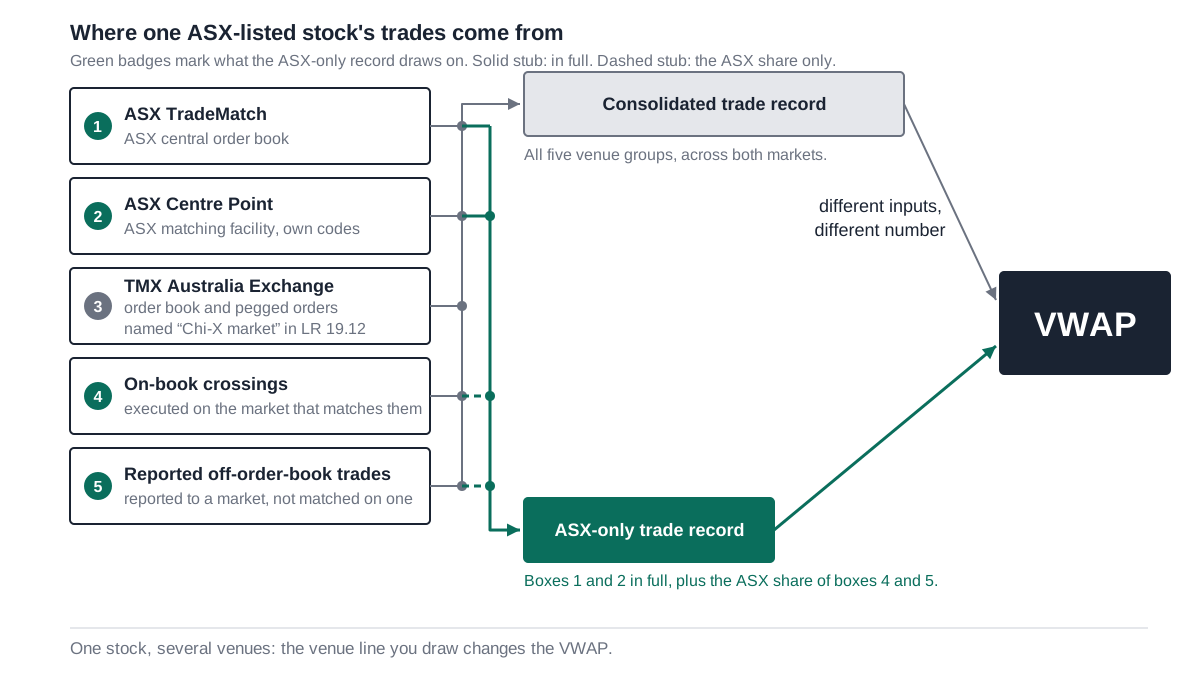
The diagram numbers the five groups in the order they are set out above, with one split worth noting: group 4 is the on-book half of Crossings, and special crossings, being reported rather than matched, sit in group 5 with the other reported trades. The ASX-only record takes groups 1 and 2 in full. It takes only the ASX share of groups 4 and 5, because a crossing belongs to the market that matched it and a reported trade to the market it was reported to, and it leaves the second exchange out altogether.
One market, three names
The second exchange has been renamed twice, and the Listing Rules have not caught up. Its operator records the sequence directly: "The TMX market was formerly known as the Cboe market and, prior to that, as the Chi-X market", and the legal entity holding the market licence, operating the market and contracting with participants and product issuers did not change through either rename (TMX Australia Exchange Operating Rules). The most recent change followed TMX Group's acquisition of the business from its previous owner, completed on 2 August 2026 US time and announced by ASIC on 3 August 2026 Sydney time (Cboe Global Markets and ASIC announcements), with the rulebook reissued under the new name the same day (TMX Australia Exchange Operating Rules).
The rules do not leave the reader to work out what to do with the old names. The same paragraph states that materials including the Market Integrity Rules, legislation and other instruments "may still reference 'Chi-X' and the 'Chi-X market' or 'Cboe Australia' and the 'Cboe Australia market' and these should be read interchangeably with 'TMX' and the 'TMX market'" (TMX Australia Exchange Operating Rules). LR 19.12 is one of those instruments. The definition still reads "+Chi-X market" in the version this guide series cites (ASX Listing Rule 19.12), and reading it as the market now called TMX is what the operator's own rules direct. Nothing in the definition's coverage moved with the names.
Practical consequence: three names, one venue. A data extract, a broker note, a rulebook and a market report written in different years may each use a different one, and a checklist that looks for the word Cboe will miss a file that says TMX and a rule that says Chi-X.
What the Listing Rules say about venue
The definition prices trading "on the +ASX market and the +Chi-X market" over the period, and its second paragraph extends the trade set to "trades executed on those markets and trades reported to those markets" (ASX Listing Rule 19.12). That is the whole of what the text says about venue. The ASX VWAP definition reads those words in context; the short version is that two markets are named, both are in, and a figure built from one alone is not the defined figure. The text says nothing about a venue that is neither of the two.
The definition names markets, not order books, so all five of the categories above sit under one or other of its limbs. The ASX market covers both the central order book and Centre Point, whose trades are ASX trade types in ASX's own mapping (ASX trade condition codes, v3.7). The second named market covers its order book and the pegged orders submitted to it (TMX Australia Exchange Operating Rules, rule 4.5). On-book crossings are executed on the market that matches them. Special crossings and other off-book transactions are reported to a market, which is what the reporting limb reaches.
The exclusions then take some of that back out, and they take out trade types rather than venues (ASX Listing Rule 19.12). Block trades and large portfolio trades come out wherever they were done, and both categories are defined by size, at $1,000,000 of consideration for a Tier 1 equity market product down to $200,000 at Tier 3, and $5,000,000 across at least 10 classes for a portfolio (ASIC Market Integrity Rules (Securities Markets) 2017, rules 6.2.1 and 6.2.2), so the largest off-book parcels are the ones the exclusions reach. What is left of the off-book set stays in. Which trades count and which are excluded settles the two cases that catch people: auctions are in, and a trade with price improvement is not among the categories LR 19.12 excludes, so an off-book trade done inside the spread or at the mid-point is not excluded on that ground.
The two readings in practice
Two bases turn up in practice. The consolidated reading takes the trade set across both markets. The ASX-only reading takes the ASX market alone. They are not equally supported by the definition, which names two markets (ASX Listing Rule 19.12). They do both turn up in published claims, though: this project's own recalculation work handles a stated ASX-only scope as a routine case rather than an oddity. Anyone checking a published VWAP therefore has to be able to compute both and tell them apart.
The gap is small per share and large in total. Take a stock that trades 300,000 shares for $600,000 of value on one market, an average of $2.00, and 100,000 shares for $208,000 on the other, an average of $2.08. The consolidated figure is $808,000 divided by 400,000 shares, or $2.02. The narrower figure is $2.00. Both divisions are correct. The two-cent gap is about one per cent of the price, which on a placement priced off that VWAP is one per cent of the money raised, and neither number tells you on its face which basis produced it.
One trap sits in the data itself. ASX's condition-code document carries
an "ASX VWAP Update" column whose published meaning is an update rule for
ASX VWAP, Y for updates and N for does not (ASX trade condition codes,
v3.7). It maps ASX trade types in an ASX document. That makes it a useful
cross-check on which of those trade types the operator itself treats as
market trading, and it says nothing at all about the second market's
trades, so a figure assembled by taking every Y row is an ASX-market
figure by construction.
The calculator behind this project computes both bases and does not treat them as equals. The consolidated basis, the full trade set across both markets run through the exclusion policy and the cancelled-trade netting, is the one a published figure is judged against, because it is the basis the Listing Rules definition describes. Where a claim states an ASX-only scope, the narrower slice is computed as well, on the same exclusion policy, but as explanation rather than as the verdict. That ordering was tested rather than assumed. On the families tested in that work, the ASX-only figure sat further from the published number than the consolidated figure rather than closer, and in the sharpest case the published figure reproduced almost exactly only on a third basis that is not defensible at all: the ASX-only book with two special crossings left in, which this project's exclusion policy removes as block trades. LR 19.12 names block trades and does not name special crossings, so treating those two prints as block trades is this project's judgement rather than the rule speaking, and which trades count and which are excluded sets out the basis for the mapping. A stated scope of "ASX only" is not by itself an account of how a number was built.
What this means for issuers
Three things follow for anyone who has to produce or defend a VWAP.
Get both markets into the extract. The trade set the definition describes spans two markets (ASX Listing Rule 19.12), and a file covering one of them will not say so on its face. Ask the question of your source before the arithmetic starts, not after someone disputes the answer.
Name the venue basis in writing. A VWAP figure carries no record of the trade set behind it. Recording that the calculation spans both markets, and which trade types were removed, is the difference between a number that can be re-derived and a number that has to be taken on trust.
For a Listing Rule 7.1A issue, part of this is already required. The Appendix 3B prompts the entity to send its ASX Listings Compliance adviser a work sheet stating the pricing date, the pricing period and the VWAP for the relevant class over that period, and the work sheet also asks the entity to identify the source of its VWAP calculation (ASX Guidance Note 21). Naming a source answers where the figure came from. It does not by itself answer which venues the source counted, which is the question this guide exists to raise, so state the basis alongside the source. Special cases and rule-specific windows covers the disclosure requirement and the rules that turn on a VWAP.