The general formula divides value traded by volume traded and stops there; the Listing Rules do not. Where a rule prices something off a VWAP it also fixes the window, sets the percentage applied to the result, and in one case requires the entity to tell ASX where the figure came from. This guide works through those mechanics rule by rule.
Why and when VWAP is used maps which situations call for a VWAP and why. This one assumes the situation is already identified and covers how the calculation is actually run: which days go in, what the arithmetic produces, and what has to go on the record.
The 15 trading day window under rule 7.1A.3
The three conditions
Securities issued under the additional 10% capacity must be in an existing quoted class of the eligible entity's equity securities, and issued for a cash consideration per security which is not less than 75% of the volume weighted average market price for securities in that class (ASX Listing Rule 7.1A.3). Only the third condition is a calculation. The first two are checks: the class has to be one already quoted, and the consideration has to be cash.
The expression "volume weighted average market price" is the Chapter 19 defined term, so the two-market trade set and the six excluded trade types apply to the figure (ASX Listing Rule 19.12). The ASX VWAP definition reads that term, which trades count and which are excluded covers the exclusions, and multi-venue trading covers combining both markets.
Counting the window backwards
The rule measures the price "over the 15 +trading days on which trades in that +class were recorded immediately before" either of two anchor dates (ASX Listing Rule 7.1A.3). Building that window is a walk backwards from the anchor, and three things govern which days it picks up.
- Start at the anchor date and step back one day at a time. The window runs immediately before the anchor, which on the ordinary reading leaves the anchor date itself out of the calculation. Why and when VWAP is used sets out why that is a reading of the words rather than something the rule states.
- Skip any day that is not a trading day. Weekends are out, as are New Year's Day, Good Friday, Easter Monday, Christmas Day and Boxing Day, and any other day ASX declares and publishes is not a trading day (ASX Listing Rule 19.12).
- Skip any trading day on which no trades in that class were recorded. Such a day is still a trading day (ASX Listing Rule 19.12), but the rule counts only the trading days on which trades were recorded, so it does not fill one of the 15 slots (ASX Listing Rule 7.1A.3).
Stop when 15 days have been collected. Every trade on those 15 days goes into the sum, and the VWAP is the single division across all of them rather than an average of 15 daily figures (how VWAP is calculated).
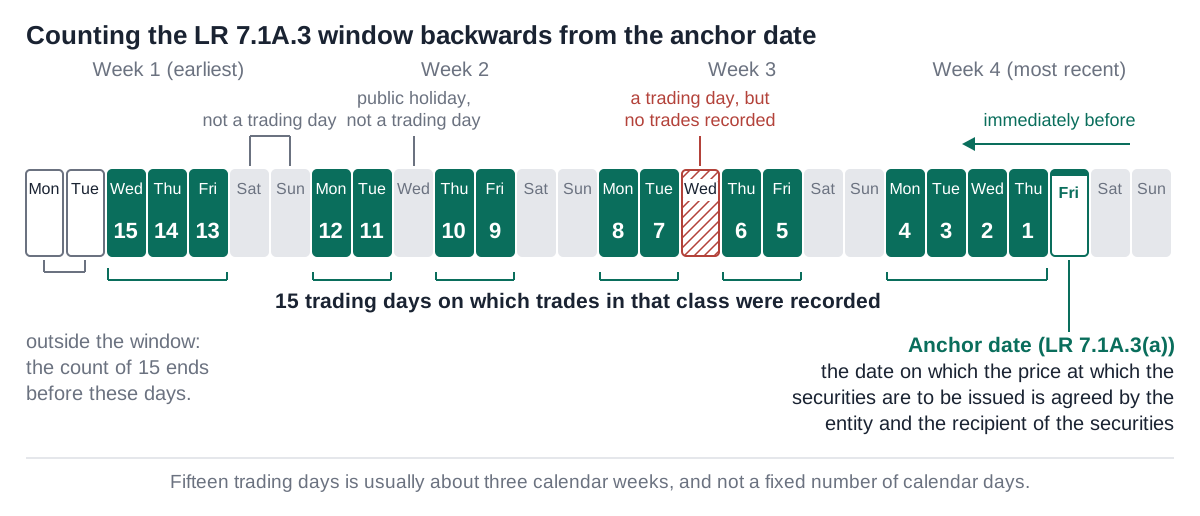
The third of those is why the calendar span of the window is not fixed. For a liquid stock the 15 days will run about three calendar weeks. For a thinly traded stock the window reaches back further, with no upper limit written into the rule.
The count is also class specific. The rule asks for trades "in that class" (ASX Listing Rule 7.1A.3), so an entity with more than one quoted class counts trading in the class being issued and ignores the rest.
Which anchor date applies
The default anchor is the date on which the price at which the securities are to be issued is agreed by the entity and the recipient of the securities. If the securities are not issued within 10 trading days of that date, the anchor becomes the date on which the securities are issued (ASX Listing Rule 7.1A.3).
The 10 trading day test in the second limb is worth reading carefully against the window it sits beside. The window counts trading days on which trades in the class were recorded; the 10 day test counts trading days without that qualification (ASX Listing Rule 7.1A.3). The same rule uses the two counts for two different jobs, so a stock that goes untraded for a stretch can use up the 10 trading days without adding a day to the 15.
Practically, the second limb means a floor is provisional until the securities are issued. If completion slips past 10 trading days, the window is recalculated against the issue date and the floor moves with it.
The floor arithmetic
The floor is 75% of the window VWAP (ASX Listing Rule 7.1A.3). Take a VWAP over the 15 day window of $0.20:
Window VWAP        = $0.20
Floor              = 0.75 × $0.20
                   = $0.15
So the securities may be issued at $0.15 or above, and not below. An issue at $0.15 exactly satisfies the rule, because the rule requires a price "not less than" 75%, not a price above it (ASX Listing Rule 7.1A.3).
Run the same arithmetic from the other end when the issue price is fixed first. Dividing the intended price by 0.75 gives the highest window VWAP the price can survive: $0.15 / 0.75 = $0.20, so at any window VWAP above $0.20 an issue at $0.15 is below the floor.
Rounding runs one way only. If the window VWAP is $0.201 rather than $0.20, the floor is 0.75 x $0.201 = $0.15075, and an issue at $0.15 is $0.00075 below it. Rounding the floor down to the nearest cent produces a price the rule does not permit. Carry the full figure, and where the floor has to be rounded to set a price, round it up. A margin can be this fine, which is the reason to carry the full figure rather than a rounded one. It is not the usual size of the problem: the errors that actually put an issue price under a floor are upstream of the rounding, in the window, the venue set and the exclusions, and they move a floor by considerably more than a rounding step. Common mistakes works through them.
Telling ASX where the VWAP came from
An issue under rule 7.1A carries a disclosure step that the arithmetic by itself does not produce. The Appendix 3B lodged when an entity announces a proposed issue of equity securities under rule 7.1A prompts the entity to send its ASX Listings Compliance adviser a completed work sheet, in the form of Annexure C to the guidance, confirming that the entity has the available capacity to issue the securities (ASX Guidance Note 21).
The work sheet requires the entity to state three things about the pricing:
- the pricing date;
- the pricing period; and
- the VWAP for securities in the relevant class over that period (ASX Guidance Note 21).
It then also asks the entity to identify the source of its VWAP calculation (ASX Guidance Note 21). The guidance draws that as a separate ask rather than a fourth stated figure, and the Annexure C line item puts it as a question: who was the source of the VWAP calculation (ASX Guidance Note 21).
On acceptable sources, the guidance is not restrictive. VWAP calculations can be obtained from ASX Customer Service or other third party service providers, and a listed entity may use any recognised information service provider as the source of its VWAP calculation (ASX Guidance Note 21).
Note what those items settle and what they do not. The pricing date and pricing period fix the window, the VWAP is the figure itself, and the source names who produced it. None of them states which markets the source counted or which trade types it removed, and those are the two questions on which two honest calculations of the same window diverge (multi-venue trading; which trades count and which are excluded). Recording the venue basis and the exclusion policy alongside what the work sheet asks for is what makes the figure reproducible later.
VWAP-priced share purchase plans
The Chapter 10 VWAP floor sits in Exception 4 to rule 10.11, and its scope is narrower than "SPPs generally". Why and when VWAP is used sets out what the exception covers, the conditions attaching to it, and two drafting points to settle before relying on it. The mechanics of the price condition are these.
The issue price must be at least 80% of the volume weighted average market price for securities in that class, calculated over the last 5 days on which sales in the securities were recorded before the day on which the issue was announced, or the day on which the issue was made (ASX Listing Rule 10.12, Exception 4).
The window is built by a backwards walk of the same shape as the 7.1A.3 window, and a day on which nothing was recorded is skipped in both. Five things differ.
The length is five days rather than 15 (ASX Listing Rule 10.12, Exception 4; ASX Listing Rule 7.1A.3).
Exception 4 says "days" where rule 7.1A.3 says "trading days" (ASX Listing Rule 10.12, Exception 4; ASX Listing Rule 7.1A.3). The backwards walk set out above imports a qualifier this rule does not use. Whether the omission is deliberate is not settled by either extract, so record which counting basis was applied.
What fills a slot is a day on which sales were recorded, where rule 7.1A.3 asks for a day on which trades were recorded (ASX Listing Rule 10.12, Exception 4; ASX Listing Rule 7.1A.3).
The thing being counted is described differently on each side of the same sentence. The price is 80% of the VWAP "for +securities in that +class", but the days counted are those on which "sales in the +securities were recorded" (ASX Listing Rule 10.12, Exception 4), where rule 7.1A.3 says "trades in that +class" in both places (ASX Listing Rule 7.1A.3). Whether "the securities" in the counting limb means the class or only the securities being issued is not settled by the extract. For an entity with a single quoted class nothing turns on it, because the two readings pick the same days. Where there is more than one quoted class, record which reading was used.
The percentage is higher, so the same VWAP produces a higher floor:
Window VWAP        = $0.20
Floor              = 0.80 × $0.20
                   = $0.16
A five day window is also more exposed to a single day than a 15 day window. Weight in a VWAP follows volume, so on days of similar size one day inside five carries roughly three times the share of the total that it would carry inside 15. That matters when a plan is priced off a period containing an announcement day.
Plans priced off a VWAP outside the exception take their window from the offer terms rather than from a rule (why and when VWAP is used), which means the offer document has to fix all three of the things a rule would otherwise fix: the number of days, what ends the window, and what fills a slot.
Performance securities
Where a performance security's milestone is a share price hurdle, ASX recommends that the hurdle be based on volume weighted average market price over a reasonable period, giving as its example 20 consecutive trading days on which the entity's securities have actually traded, rather than the market price at a particular date or over a shorter period (ASX Guidance Note 19). Why and when VWAP is used covers where these instruments sit and why ASX takes that position.
The example counts days on which the securities actually traded, so the window is built by the same backwards walk as the placement window (ASX Guidance Note 19; why and when VWAP is used).
What differs is what the finished figure is for, and it changes how often the calculation runs. A placement VWAP sets a minimum price and is worked out once against a fixed anchor. A hurdle VWAP is compared against a threshold, and where the terms allow the hurdle to be met at any time before an expiry date, there is no single anchor: the comparison has to be re-run as each new day of trading is added, and the window slides forward with it. That is a materially bigger job than one placement calculation, over a period measured in years rather than weeks, and the terms rather than the guidance decide whether it is what the instrument requires. A hurdle measured once at a stated date is a different calculation from one tested on a rolling basis, and the two can give different answers on the same trading.
Whether the terms settle that question, and the venue and exclusion questions alongside it, is a matter of how they were drafted (why and when VWAP is used). Where they do not, the choices fall to whoever runs the calculation, and the only useful response is to record which ones were made.